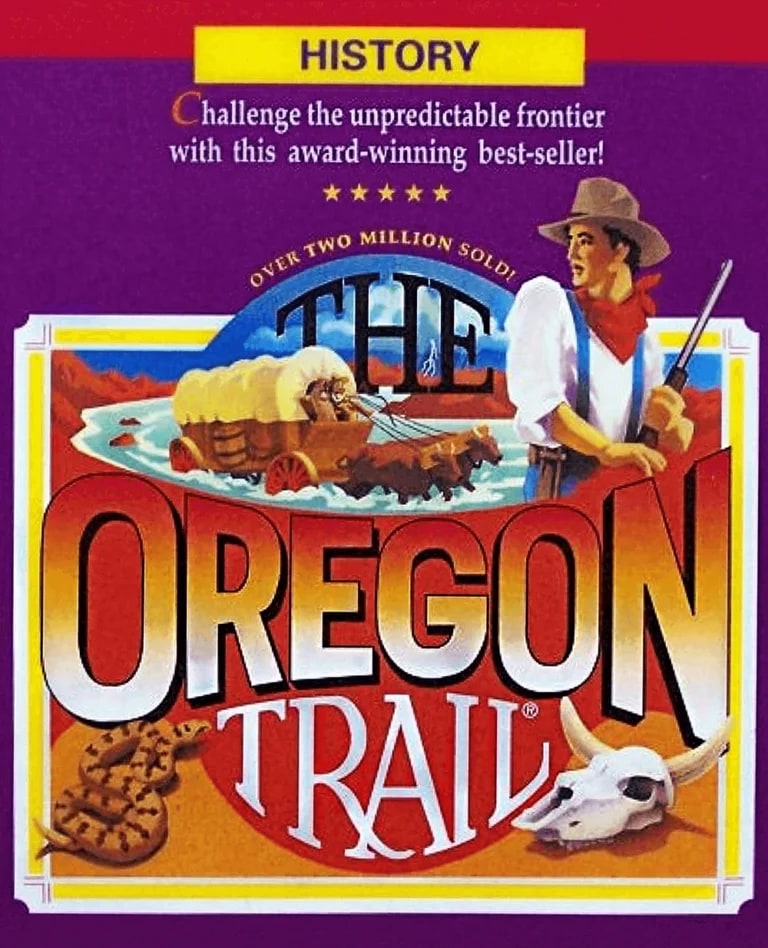
What is The Oregon Trail Deluxe?
The Oregon Trail Deluxe is the version of The Oregon Trail that MECC released for MS-DOS computers in 1992, and it is the one you can play on this site. You lead a wagon party of five from Independence, Missouri, to Oregon's Willamette Valley in 1848. You buy the supplies, set the pace and the food rations, and decide how to cross each river. The game calls it a journey of about 2,000 miles, and it takes several months of game time.
Deluxe keeps the design of MECC's 1985 Apple II game, the version many people remember from school, and gives it a new face. You play with the mouse, clicking buttons for the map, the Guide, your supplies, trading, talking, resting and hunting. The pictures were redrawn in VGA color, the game plays sound effects and music, and there are eight occupations to choose from instead of three.
Getting ready in Independence
Every trip starts with a name and a job. You name yourself and the four people in your wagon, then pick an occupation. Your job sets how much money you start with, gives some people a useful skill, and decides how much your final score is multiplied.
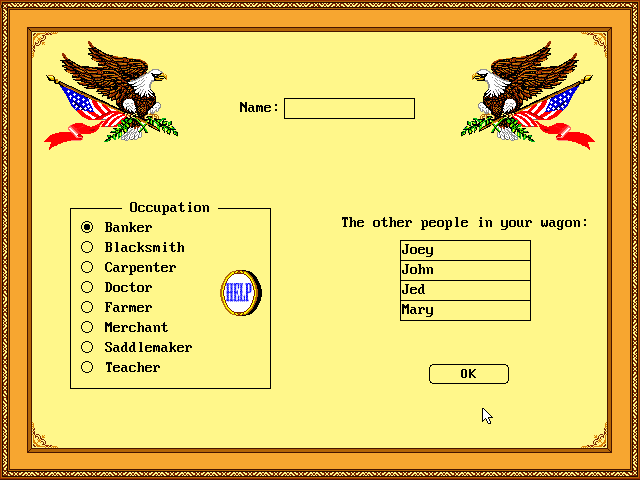
Bankers start with $1,600 and get no bonus. Doctors start with $1,200 and get no bonus either, but their sick or injured travelers are less likely to die. Merchants also start with $1,200 and earn one and a half times the points. Blacksmiths and carpenters start with $800, are better at fixing broken wagon parts and earn double points. Saddlemakers start with $800 and earn two and a half times the points. Farmers start with $400, their oxen are less likely to get sick and die, and they earn triple points. Teachers also start with $400 and earn three and a half times the points.
Then you shop at Matt's General Store for oxen, clothing, bullets, spare wheels, axles and tongues, and food. Matt suggests at least six oxen, two sets of clothing for each person and at least 200 pounds of food per person. Forts along the way sell supplies too, but for more than Matt charges. Last, you choose when to leave. Go too early and there is little grass for the oxen and a risk of late spring snow. Go too late and you may not reach Oregon before winter.
Life on the trail
Once you roll out, the wagon moves on its own and the days tick by. A Conditions panel shows the date, the weather, your food and your party's health, and a trail log records everything that happens. You can stop any time to check your supplies, look at the map, read the Guide, trade with people you meet or talk to them.
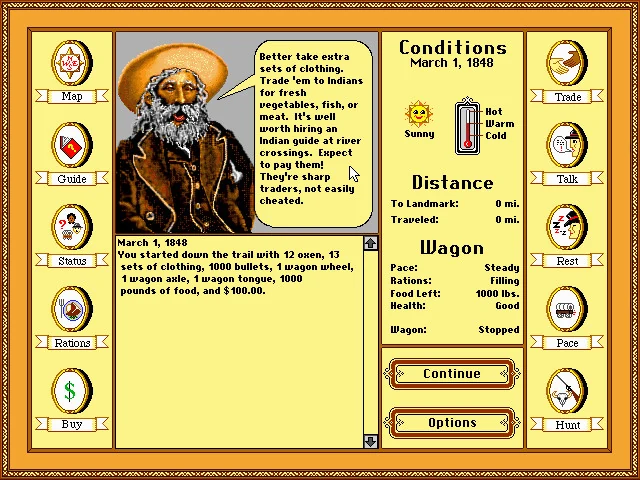
Three settings shape the journey. The pace can be steady (8 hours of travel a day), strenuous (12 hours) or grueling (16 hours). Rations can be filling, meager or bare bones. You can also stop and rest for one to nine days. Pushing harder gets you there sooner, but exhausted, hungry travelers pay for it with their health.
Trouble comes in many forms: a broken wheel, axle or tongue, a thief, an ox that wanders off, bad water or no water at all, a fire in the wagon. People come down with cholera, dysentery, measles, typhoid or a fever, break an arm or a leg, or get bitten by a snake. Rest and good food help them recover. Sometimes they do not, and the trail log records who died.
Rivers, forks and the last stretch
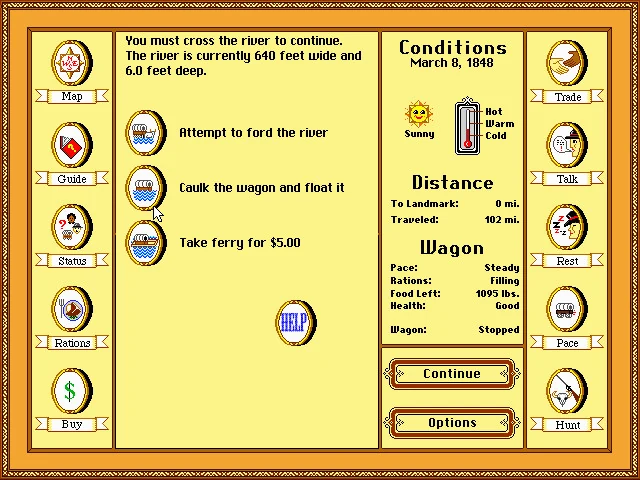
The rivers to cross include the Kansas, the Big Blue and the Snake, plus the Green River if you take the shortcut after South Pass. At each crossing the game tells you how wide and how deep the water is. You can ford it, caulk the wagon and float it across, or pay for a ferry where one runs. At some crossings you can hire a Native guide in exchange for three sets of clothing. The built-in Guide gives the rule of thumb: ford only in slow water less than two and a half feet deep.
The trail also divides. After South Pass you can head for Fort Bridger to buy supplies or take a shortcut to the Green River. In the Blue Mountains you choose between Fort Walla Walla and a shortcut to The Dalles. At The Dalles comes the last choice: pay the toll for the Barlow Road, or raft down the Columbia River and steer around the rocks with your mouse.
Hunting
When food runs low you can go hunting, as long as you have bullets. You aim with the mouse and click to fire at bison, deer and other animals as they cross the screen. However much you shoot, you can carry only part of the meat back to the wagon, and if you keep hunting in the same area, game becomes scarce.
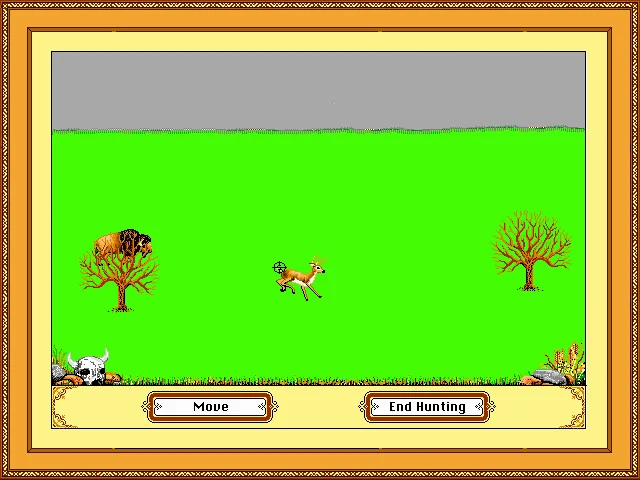
The game will not let you hunt in severe weather, or near some landmarks where there are too many people around. On the Options screen you can set how long each hunting trip lasts.
Scoring and the List of Legends
If you reach the Willamette Valley, the game adds up your score. Each traveler who arrives earns points depending on their health, and you get points for the wagon and what is left in it: oxen, spare parts, clothing, bullets, food and money. Then the total is multiplied by your occupation's bonus, which is why a teacher who makes it scores so much more than a banker.
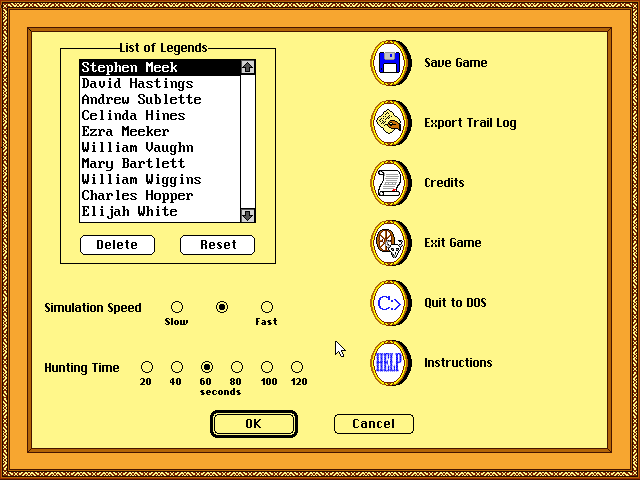
The ten best scores go on The Oregon Trail List of Legends. Out of the box, the list is filled with the names of people from the trail's history, such as Stephen Meek and Ezra Meeker. On this site you can also post your score to the leaderboard, under a name you choose.
Where Deluxe came from
MECC first gave The Oregon Trail mouse controls in a black-and-white Macintosh version in 1991. A year later the same design came to MS-DOS computers in color. MECC's own history describes the 1992 release as bringing the Macintosh desktop interface to MS-DOS, with high-resolution VGA graphics, digitized sound and MIDI music. R. Philip Bouchard, who led the 1985 design, writes that these mouse versions kept the game's structure and its underlying math, and added some new details.
The word Deluxe in the name sets this release apart from the earlier MS-DOS version. The disks call it the Deluxe VGA Edition, version 3.0, and the game itself simply says The Oregon Trail. It needed a VGA display and a mouse, normally ran in 16-color VGA, and could show more colors on video cards that supported it. The team at MECC included Wayne Studer, who went on to design Oregon Trail II, and Charolyn Kapplinger, lead artist of the 1985 game.
When Compute! magazine reviewed the new deluxe VGA edition in November 1993, it called the game easy for older elementary school children to learn and interesting enough for adults. MECC was still selling the MS-DOS Deluxe VGA edition in 1997, next to its Windows and Macintosh versions. When PC Gamer ranked the versions of The Oregon Trail in 2020, Deluxe came first.
Playing it here
The Oregon Trail Deluxe runs right in your web browser. It is free, there is nothing to download, and you do not need an account to play. The game was made for a mouse, so a mouse or a trackpad works best.
To keep a trip for later, open Options and choose Save Game. As a guest, your saved games stay in this web browser. If you are 13 or older, an optional account keeps them for you, and with a Google account they follow you to other computers.
Notable systems
- Mouse controls, with a button for every action
- Eight occupations with different money, skills and score bonuses
- Pace, rations and rest settings that change your party's health
- Four ways to cross some rivers: ford, float, ferry or a hired guide
- Forks in the trail after South Pass, in the Blue Mountains and at The Dalles
- Hunting with a mouse-aimed rifle and a limit on the meat you can carry
- A built-in Guide with short articles on landmarks, diseases and Native nations
- A trail log you can save as a text file
- The List of Legends, the game's ten best scores
More from the game
18 frames from The Oregon Trail Deluxe, at the resolution it originally ran at. Pick one to see it at full size.